
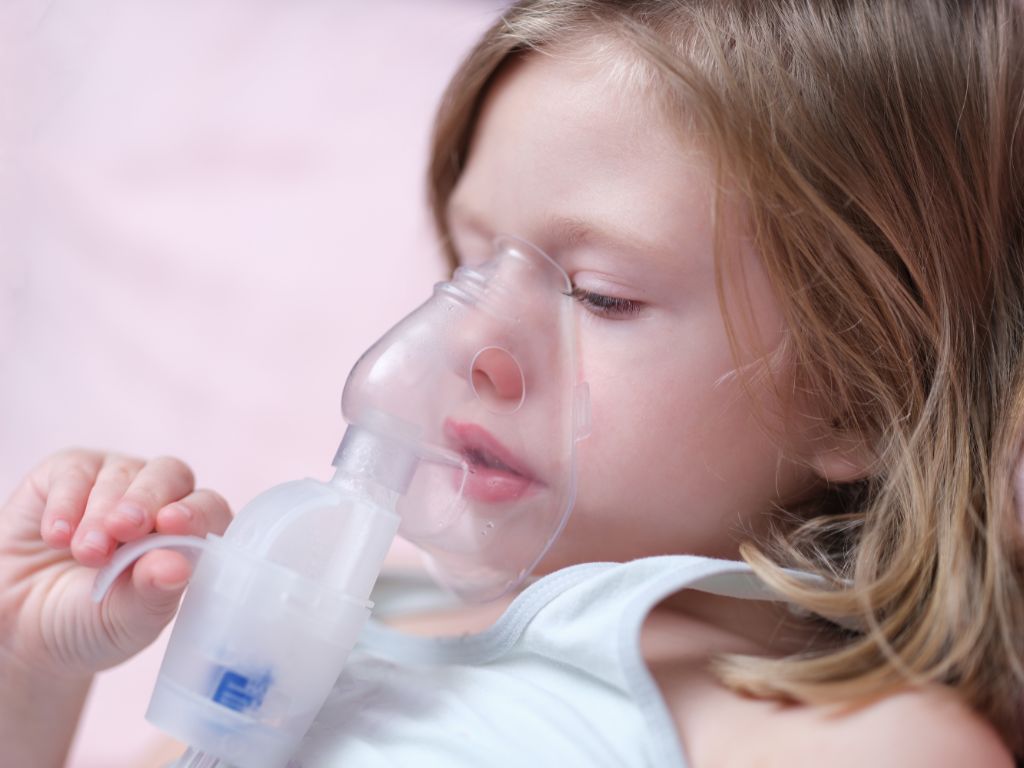
El Dr. Álvar Agustí advierte de la “epoc Young” y pide realizar espirometrías en la infancia y juventud
La enfermedad pulmonar obstructiva crónica (epoc ) es una afección respiratoria que no solo afecta a los hombres fumadores, sino también a las mujeres y a los jóvenes, conocida en este caso como ‘EPOC Young’, por lo que es importante hacer espirometrías también en la infancia y juventud para detectarla precozmente, según ha apuntado el neumólogo e investigador de Barcelona Respiratory Network (BRN), el Dr. Àlvar Agustí.
“En los primeros años de vida, durante el embarazo, la infancia y la adolescencia, puede haber factores que alteren el desarrollo de los pulmones y que conduzcan a la epoc en personas jóvenes, de 20-25 años, como la prematuridad, el bajo peso al nacer, las infecciones repetidas durante la infancia, la mala dieta o que la madre fume durante el embarazo”, ha explicado el Dr. Agustí. Aunque el tabaquismo es un factor de riesgo muy importante para el desarrollo de la EPOC, la enfermedad también puede estar provocada por otros factores de riesgo genéticos y ambientales que pueden influir negativamente en el desarrollo de los pulmones del feto, el niño y el adolescente y alterar la función pulmonar de los jóvenes.
Puedes leer el artículo completo aquí: https://isanidad.com/260701/el-dr-alvar-agusti-advierte-de-la-epoc-young-y-pide-realizar-espirometrias-en-la-infancia-y-juventud/
Noticias relacionadas

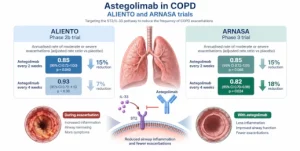
Safety and efficacy of astegolimab for COPD with frequent exacerbations regardless of baseline blood eosinophil counts (ALIENTO and ARNASA): randomised, double-blind, placebo-controlled, phase 2b and 3 trials
Astegolimab for COPD was evaluated in the ALIENTO and ARNASA trials to assess its efficacy and safety in patients with frequent exacerbations.
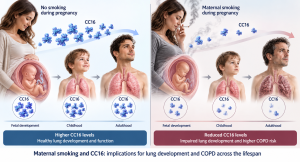
Maternal smoking and CC-16: implications for lung development and COPD across the lifespan
Maternal smoking and CC16 are linked to impaired lung development, lung function decline and emphysema progression, increasing lifelong COPD risk.
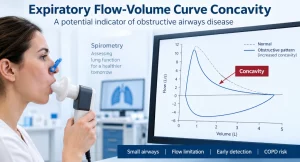
Concavity of the maximal expiratory flow–volume curve, and incidence of COPD and respiratory symptoms: a population-based cohort study
Expiratory flow-volume curve concavity predicts future respiratory symptoms but shows lower discriminatory accuracy for COPD incidence than FEV1/FVC.
Artículos
EPOC
- 759788·Alvar Agustí, Rod Hughes, Eleni Rapsomaki, Barry Make, Ricardo Del Olmo, Alberto Papi, David Price, Laura Benton, Stefan Franzen, Jørgen Vestbo, Hana Mullerova – The many faces of COPD in real life: a longitudinal analysis of the NOVELTY cohort
- 759883·Alberto Papi, Rosa Faner, Ian Pavord, Federico Baraldi, Vanessa M McDonald, Mike Thomas, Marc Miravitlles, Nicholas Roche, Alvar Agustí. – From treatable traits to GETomics in airway disease: moving towards clinical practice
- 768778·Alvar Agusti, Claus F. Vogelmeier – GOLD 2024: a brief overview of key changes
- 768799·Surya P Bhatt Richard Casaburi Alvar Agusti et Al. Chronic obstructive pulmonary disease: hiding in plain sight, a Statement from the COPD Foundation Medical and Scientific Advisory Committee
- 769092·Leonardo M Fabbri et al. COPD and multimorbidity: recognising and addressing a syndemic occurrence
Imagen obtenida en Canva Pro.