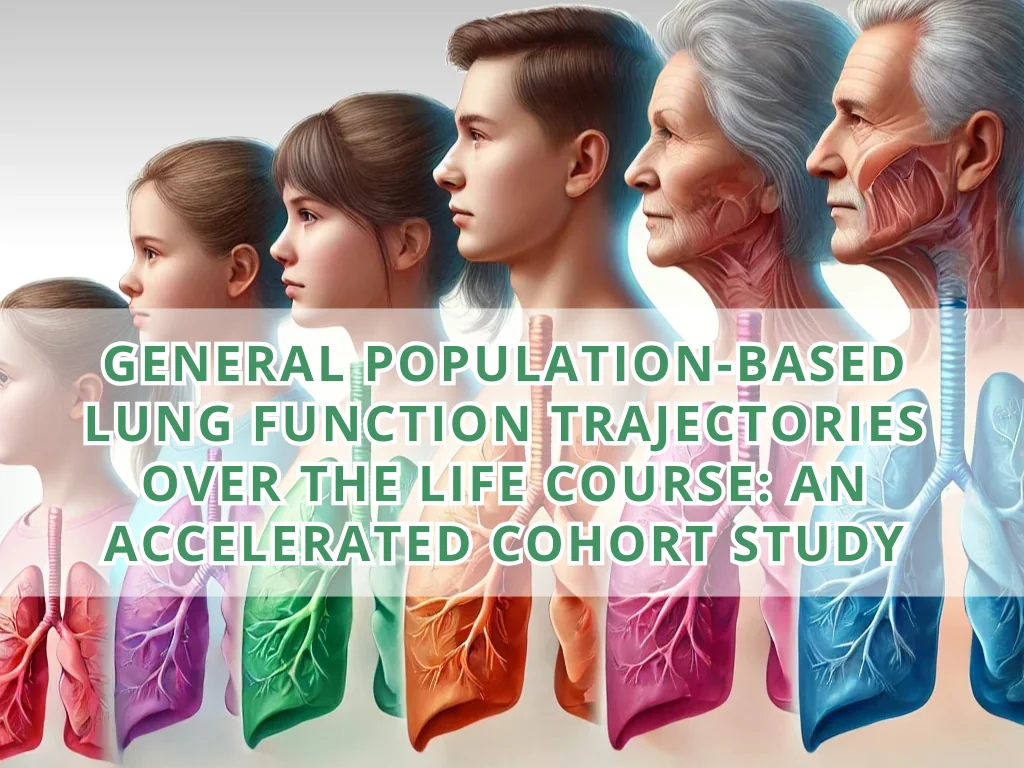

General population-based lung function trajectories over the life course: an accelerated cohort study
Understanding life course lung function trajectories: background and aim
Lung function is a key determinant of health, but current knowledge on lung function growth and decline over the life course is based on fragmented, potentially biased data.
We aimed to empirically derive general population-based life course lung function trajectories, and to identify breakpoints and plateaus.
How life course lung function trajectories were studied: methods from eight cohorts
We created an accelerated cohort by pooling data from eight general population-based child and adult cohort studies from Europe and Australia.
We included all participants with information on lung function, smoking status, BMI, and asthma diagnosis status from at least two visits.
We used cross-classified three-level linear mixed models to derive sex-specific life course trajectories of FEV1, forced vital capacity (FVC), and FEV1/FVC ratio based on observations at ages 4–80 years, and Bayesian time-series decomposition to identify breakpoints and plateaus.
We repeated sex-specific analyses with separate stratification for asthma status (never had asthma vs persistent asthma, where persistent was defined as the risk factor being present at all participant visits) and smoking status (never smoker vs persistent smoker).
What life course lung function trajectories reveal: key interpretation
In both sexes, FEV1 and FVC increased in two phases, with a fast increase until around age 13–16 years, and then a slower increase until a peak.
Neither parameter showed a plateau phase after the peak, and decreases started earlier than previously described. FEV1/FVC ratio decreased throughout life.
These observations provide an essential, but previously unavailable, framework to assess and monitor lung health over the life course.
Authors
Prof Judith Garcia-Aymerich PhD, Martí de las Heras BStats, Anne-Elie Carsin MSc, Prof Simone Accordini MSc, Prof Alvar Agustí MD, Dinh Bui PhD, Prof Shyamali C Dharmage PhD, Prof James W Dodd PhD, Ikenna Eze PhD, Ulrike Gehring PhD, Prof Thorarinn Gislason MD, Raquel Granell PhD, Medea Imboden PhD, Carmen Íñiguez PhD, Ayoung Jeong PhD, Sarah Koch PhD, Prof Gerard H Koppelman PhD, Bénédicte Leynaert PhD, Prof Erik Melén MD, Jennifer Perret PhD, Prof Nicole Probst-Hensch PhD, Loreto Santa-Marina PhD, Maties Torrent PhD, Don Vicendese PhD, Judith M Vonk PhD, Maaike de Vries PhD, Prof E Haydn Walters DM, Gang Wang MD, Prof Jadwiga A Wedzicha MD, Prof Deborah Jarvis MD, Rosa Faner PhD
Read more details at
Fecha de publicación
Available online 15 May 2025
Categorías asociadas al artículo
Noticias relacionadas

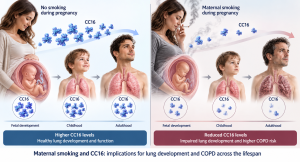
Maternal smoking and CC-16: implications for lung development and COPD across the lifespan
Maternal smoking and CC16 are linked to impaired lung development, lung function decline and emphysema progression, increasing lifelong COPD risk.
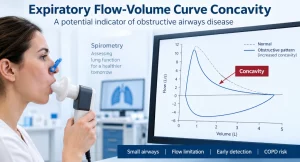
Concavity of the maximal expiratory flow–volume curve, and incidence of COPD and respiratory symptoms: a population-based cohort study
Expiratory flow-volume curve concavity predicts future respiratory symptoms but shows lower discriminatory accuracy for COPD incidence than FEV1/FVC.
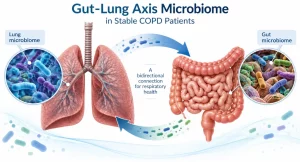
Characterisation of the gut-lung axis microbiome in clinically stable patients with chronic obstructive pulmonary disease
Gut-lung axis microbiome analysis in stable COPD reveals distinct gut and lung microbiomes associated with airflow limitation, exacerbations and ICS use
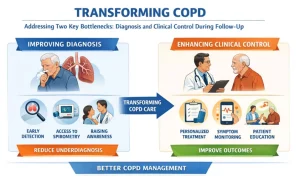
Transforming COPD by Addressing Two Key Bottlenecks: Diagnosis and Clinical Control During Follow-up
Learn why earlier COPD diagnosis and better clinical control during follow-up are essential to reduce exacerbations, improve quality of life and optimise patient outcomes.
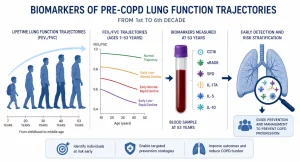
Biomarkers of Pre-COPD Lung Function Trajectories in Middle Age: A Prospective Study From 1st to 6th Decade
Blood biomarkers including CC16, sRAGE and SPD identify pre-COPD lung function trajectories and may improve early COPD risk detection and prevention.

The EXACERBANTES Study (Exacerbation of Chronic Obstructive Pulmonary Disease According to the ANTES Proposal): Rationale, Goals and Design
The EXACERBANTES Study explores treatable traits in COPD exacerbations, aiming to improve risk assessment and support personalized clinical management.
Imagen desarrollada DALL·E y Canva