
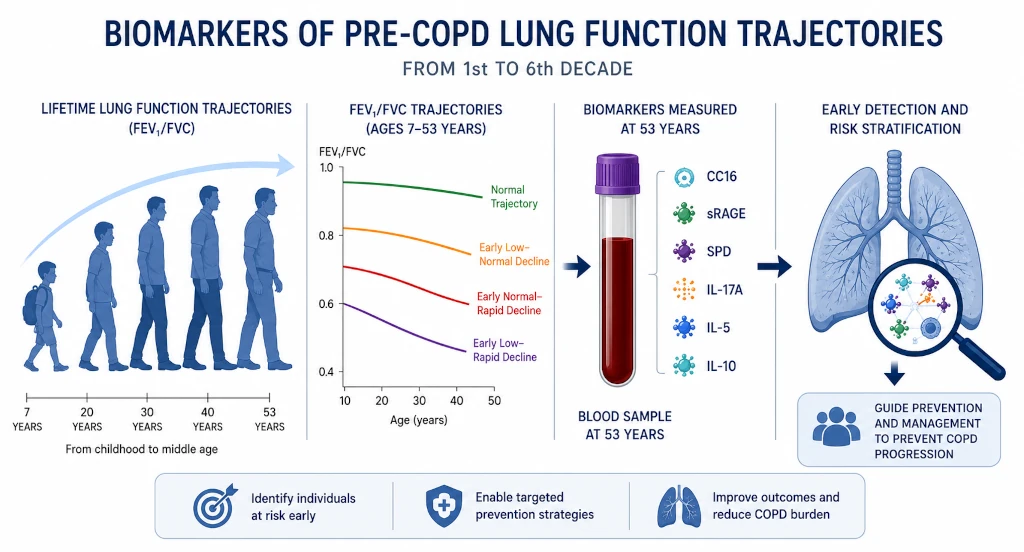
Biomarkers of Pre-COPD Lung Function Trajectories in Middle Age: A Prospective Study From 1st to 6th Decade
Pre-COPD Biomarkers and Lifetime Lung Function Trajectories
Multiple lifetime lung function trajectories can lead to COPD
It is now recognised that multiple different lifetime lung function trajectories can lead to COPD.
Identifying an individual’s lung function trajectory and understanding the potential underlying biological mechanisms may be critical from both public health and clinical perspectives.
Biomarkers may help identify pre-COPD lung function trajectories
Methods:
However, this remains a major challenge as establishing a person’s trajectory requires repeated lung function measures beginning from childhood, but such data are rarely available in clinical practice.
To address this gap, there is a pressing need to investigate more immediately pragmatic approaches to identify likely lung function trajectories.
The use of biomarkers has emerged as a promising approach for providing insights into underlying biological mechanisms and distinguishing disease trajectories.
Study objective
Blood biomarkers in pre-COPD trajectories
This study aimed to investigate/characterise potential blood biomarkers in pre-COPD FEV1/FVC trajectories with a particular view to identifying whether biomarkers differ between pre-COPD trajectories and normal controls, as well as between relatively stable pre-COPD from progressive rapid declining pre-COPD.
Biomarkers are active during the pre-COPD phase
In conclusion, we show that several biomarkers, including CC16, sRAGE, SPD and several cytokines, present in middle age, differ significantly across pre-COPD lung function trajectories.
These findings suggest that COPD-specific pathobiological processes, such as lung damage and inflammation, are already active during the pre-COPD phase.
Importantly, our findings underscore the potential of these biomarkers for early detection and risk stratification.
This opens the door to establishing validated algorithms based on both biomarkers and clinical history, with the ultimate goal of translating such tools into routine clinical practice for earlier and more targeted prevention of COPD.
Authors
Dinh S. Bui, Don Vicendese, Jonathan Pham, Nur Sabrina Idrose, Adrian Lowe, Caroline Lodge, Raisa Cassim, Chamara Senaratna, Gayan Bowatte, Garun Hamilton, Alan James, Paul Thomas, Richard Wood-Baker, Peter Frith, Gary Anderson, Philip M. Hansbro, Graeme Zosky, George Washko, Michael J. Abramson, Rosa Faner, Alvar Agusti, Jennifer Perret, E. Haydn Walters, Shyamali C. Dharmage
Read more details at
Fecha de publicación
13 July 2026
Categorías asociadas al artículo
Noticias relacionadas

ECLIPSE: un estudio de tres años que cambió nuestra forma de entender la EPOC
A 20 años de ECLIPSE, repasamos el estudio que transformó la comprensión de la EPOC, revelando su heterogeneidad, progresión y biomarcadores clave.
Systemic Immune Dysregulation in Patients With Bronchiectasis and Chronic Pseudomonas aeruginosa Infection
Study reveals systemic immune alterations in bronchiectasis patients with chronic Pseudomonas infection, highlighting persistent immune imbalance.
Origenes tempranos de las enfermedades crónicas del adulto
Charla de Alvar Agistí en el H. La Paz sobre los orígenes de las enfermedades crónicas. tempranos en la sesión titulada: Orígenes tempranos de las enfermedades crónicas del adulto. El 24/09/2025
Different Immune Infiltrate in Idiopathic Pulmonary Fibrosis Patients With Stable and Progressive Disease
Research on idiopathic pulmonary fibrosis reveals how immune infiltrate differences in early stages influence disease progression. Study highlights the role of B cells, T cells, and NK cells as potential biomarkers.
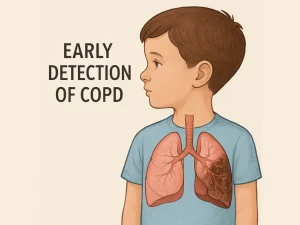
Towards early detection and disease interception of COPD across the lifespan
Discover how early-life genetic and environmental factors contribute to COPD and how emerging strategies aim to detect and intercept the disease early. Review from the European Respiratory Review, July 2025
Metabolomic Plasma Profile of Chronic Obstructive Pulmonary Disease Patients
This study identifies a metabolic signature of COPD patients, involving fatty acids, amino acid and carbohydrate metabolites, using LC-MS plasma profiling.
Imagen desarrollada con ChatGPT