
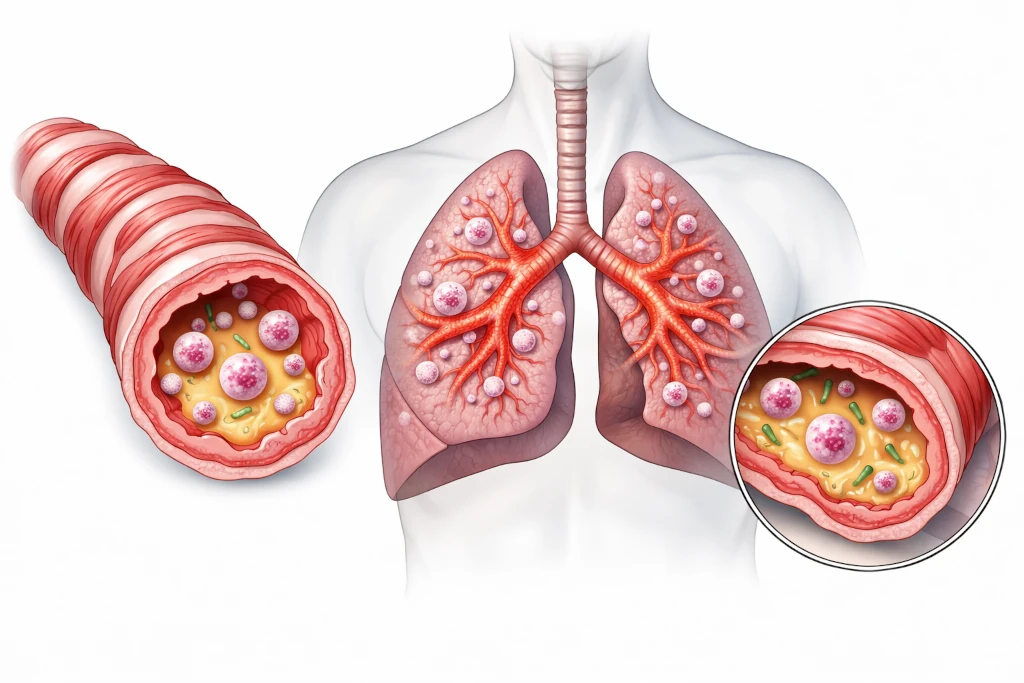

Clinical, molecular and microbial characterisation of the eosinophilic endotype of bronchiectasis: data from the EMBARC-BRIDGE study
Objectives: eosinophilic bronchiectasis and airway inflammation
Eosinophilic bronchiectasis is defined by a blood eosinophil count (BEC) ≥300 cells/µL, but blood eosinophils imperfectly reflect airway eosinophilic inflammation.
Here, we investigated the relationship between eosinophilic airway inflammation, blood eosinophils and clinical severity in bronchiectasis and explored the phenotype associated with eosinophilic bronchiectasis.
Methods: sputum eosinophil proteins and LC-MS/MS analysis
Sputum from 180 patients with stable CT-confirmed bronchiectasis was utilised to investigate airway levels of eosinophil proteins (eosinophil peroxidase (EPX), eosinophil derived-neurotoxin (EDN), eosinophil cationic protein (ECP), major basic protein (MBP) and Galectin-10 (Gal-10)) using a novel stable isotope dilution liquid chromatography-tandem mass spectrometry (LC-MS/MS) assay.
To profile eosinophilic bronchiectasis, a nested analysis of patients with BEC <150 cells/µL (n=52) and ≥300 cells/µL (n=49) was conducted.
Results: association with Pseudomonas aeruginosa and Aspergillus sensitisation
Results Sputum concentrations of Gal-10, ECP and EDN were weakly but significantly associated with radiological severity, FEV1 and sputum culture positivity for Pseudomonas aeruginosa. Airway eosinophil protein concentrations did not associate with exacerbation frequency. Total eosinophil protein concentration moderately correlated with BECs (r=0.33 95% CI 0.14 to 0.49, p=0.0007).
Nested analysis revealed increased sputum PCR-positivity for P. aeruginosa (26.7% vs 7.7%, p=0.033) and an increased frequency of patients showing signs of Aspergillus sensitisation (defined as Aspergillus-specific IgE titres >0.35 kUA/L, 24.5% vs 3.8%) in eosinophilic bronchiectasis.
Sputum inflammatory biomarkers and clinical parameters did not differ between groups.
Conclusions: added value of airway eosinophilic measurement
LC-MS/MS can detect eosinophilic inflammation within bronchiectasis sputum. Weak associations between elevated airway eosinophil proteins, bronchiectasis severity and P. aeruginosa infection were observed.
Direct measurement of eosinophilic airway inflammation provides additional information in addition to BECs.
Eosinophilic bronchiectasis associated with P. aeruginosa infection and Aspergillus sensitisation.
Authors
Jennifer Pollock, Jeffrey T J Huang, Morven Shuttleworth, Merete B Long, Hollian Richardson, Daniela Alferes de Lima, Elena Kuzmanova, Clare Clarke, Michal Shteinberg, Stefano Aliberti, Charles Haworth, Sanjay Haresh Chotirmall, Eva Polverino, Pieter C Goeminne, Michael Loebinger, Natalie Lorent, Felix C Ringshausen, Oriol Sibila, Eva Rodriguez-Suarez, Christopher McCrae, Amelia Shoemark, James D Chalmers
Read more details at
Fecha de publicación
First published February 13, 2026
Categorías asociadas al artículo
Noticias relacionadas

Bronchiectasis and treatable traits: the journey from concept to clinical practice
Review of the treatable traits approach in bronchiectasis, exploring phenotypes, endotypes, comorbidities, and its translation into clinical practice.
Systemic Immune Dysregulation in Patients With Bronchiectasis and Chronic Pseudomonas aeruginosa Infection
Study reveals systemic immune alterations in bronchiectasis patients with chronic Pseudomonas infection, highlighting persistent immune imbalance.
Symptoms, risk of future exacerbations, and response to long-term macrolide treatment in bronchiectasis: an observational study
Observational study shows bronchiectasis symptoms independently predict exacerbations and identify patients who benefit from macrolide therapy, even with few prior episodes.

A Bispecific Monoclonal Antibody Targeting Psl and PcrV for Chronic Pseudomonas Aeruginosa Infection in Patients With Bronchiectasis: Results From a Randomized, Double-Blind Placebo-Controlled Trial (GREAT-2)
The GREAT-2 trial shows that gremubamab significantly reduces Pseudomonas aeruginosa load and enhances quality of life in bronchiectasis patients. Discover the results now.

Treatable Traits. Why, What, How?
Discover how the Treatable Traits approach transforms the management of asthma, bronchiectasis, and COPD through personalized precision medicine strategies.
Chronic Airways Assessment Test (CAAT)
The CAAT is a standardized 8-item questionnaire to assess health status in people with asthma, COPD, and other airway diseases. Now validated beyond COPD.
Imagen desarrollada con ChatGPT