
Key recommendations for primary care from the 2026 GOLD update

2026 GOLD update
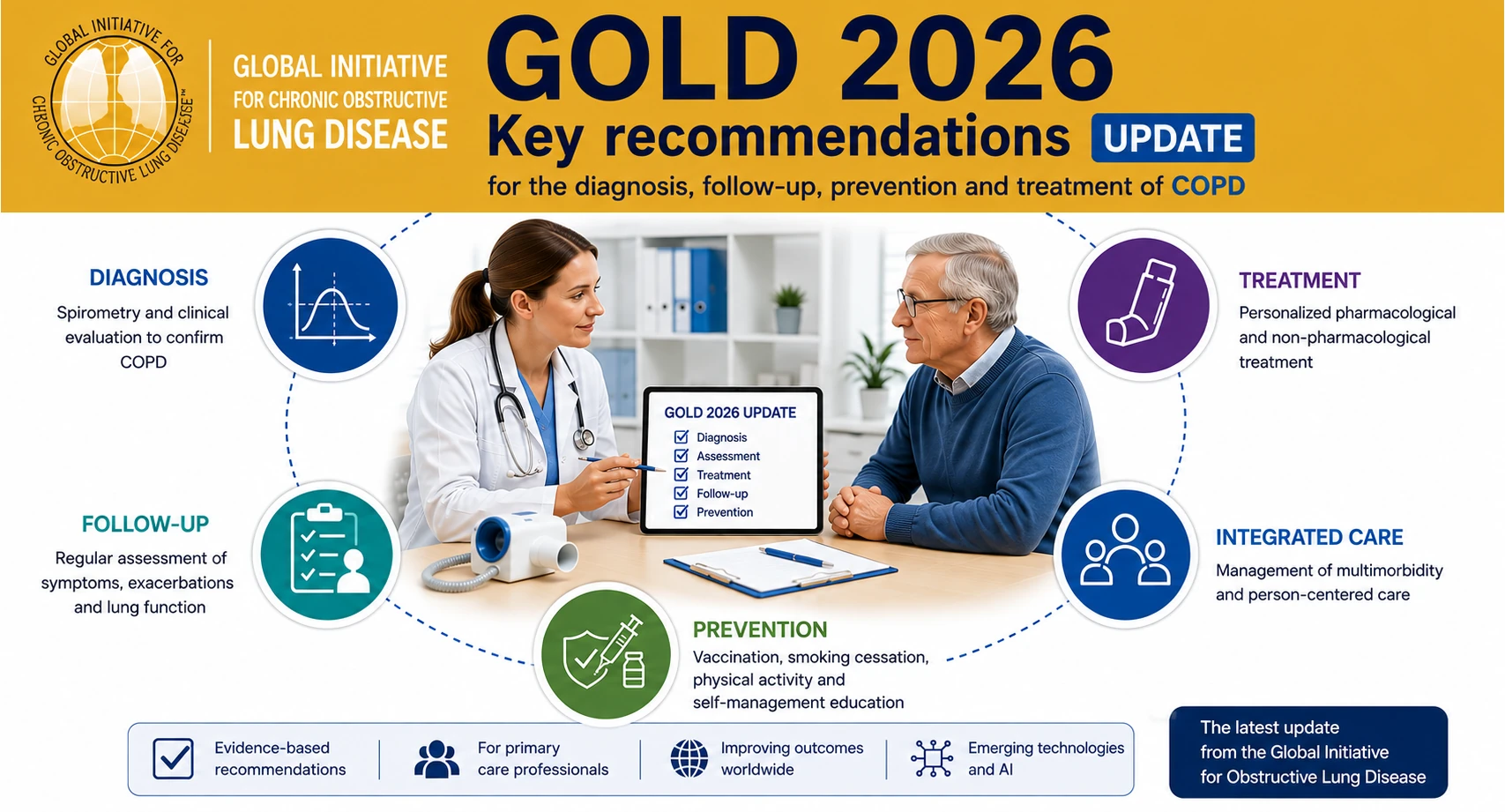
2026 GOLD update: key recommendations for primary care on COPD diagnosis, assessment, prevention, treatment, exacerbations and emerging technologies.

2026 GOLD Update: Key Recommendations for Primary Care

What Has Changed in the 2026 GOLD Update

Chronic obstructive pulmonary disease (COPD) is a major, global, public health problem.

Despite significant advances in our understanding of the pathobiology of the disease and the availability of novel treatments, COPD currently ranks third as a global cause of death.

The Global Initiative for Obstructive Lung Disease (GOLD) has produced yearly recommendations for the diagnosis and management of patients with COPD since 2001.

Here, we summarize the key recommendations of the GOLD 2026 document for a primary care audience, highlighting what has changed and what has not since the last document in 2025.

2026 GOLD Update for COPD Diagnosis and Assessment

The definition of COPD and its clinical presentation have not changed since GOLD 2025. By contrast, the sections on exacerbations and multimorbidity have been extensively updated.

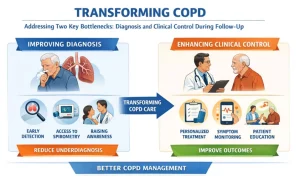
The diagnosis of COPD continues to require the demonstration of post-bronchodilator airflow obstruction (FEV1/FVC<0.7) in the appropriate clinical context (symptoms and exposures). Yet, there is extensive under-diagnosis and misdiagnosis of COPD. This is important because it results in patients receiving no treatment or incorrect treatment.

COPD Treatment and Follow-Up in the 2026 GOLD Update

The criteria defining GOLD A, B and E categories have been adjusted, so GOLD 2026 proposes that any patient with at least one previous moderate exacerbation (i.e., treated ambulatorily with antibiotics and/or systemic corticosteroids) be included in the E group, irrespective of her/his level of symptoms (Figure 2).

Inhaler technique and adherence need to be assessed regularly since this is arguably the single highest-impact intervention on symptom control, exacerbations and cost in Primary Care. A substantial share of apparent “treatment failures” are in fact due to technique error or non-adherence.

Pharmacological treatment options during follow-up have not changed from GOLD 2025, except that a new biologic (mepolizumab) has been added to dupilumab (already present in 2025) in patients who, despite receiving triple therapy, still suffer exacerbations and have ≥300 Eosinophils/μL in blood.

Prevention and Emerging Technologies in the 2026 GOLD Update

People with COPD should receive the following recommended vaccinations: influenza, SARS-CoV-2 pneumococcus, shingles and respiratory syncytial virus. Tdap vaccination (dTaP/dTPa; pertussis, tetanus and diphtheria) are recommended for people with COPD who were not vaccinated in adolescence.

Self-management education and training, application of telehealth, and multidisciplinary coordinated care are important to uphold future COPD care and research in primary care.

There is a new chapter in GOLD 2026 on artificial intelligence in the diagnosis, assessment, clinical management, and prediction of prognosis of COPD.

Authors

Alvar Agustí, Marc Vila, Antoni Sisó-Almirall, Miguel Roman-Rodriguez, Claus F. Vogelmeier

Read more details at

Fecha de publicación

Publication date: 31 July 2026

Categorías asociadas al artículo

Noticias relacionadas

Imagen desarrollada y refinada con ChatGPT

Entérate de
Nuestras Publicaciones

Loading
Logotipo Universitat de Barcelona - Càtedra de Salut Respiratòria
Resumen de privacidad

Esta web utiliza cookies para que podamos ofrecerte la mejor experiencia de usuario posible. La información de las cookies se almacena en tu navegador y realiza funciones tales como reconocerte cuando vuelves a nuestra web o ayudar a nuestro equipo a comprender qué secciones de la web encuentras más interesantes y útiles.