
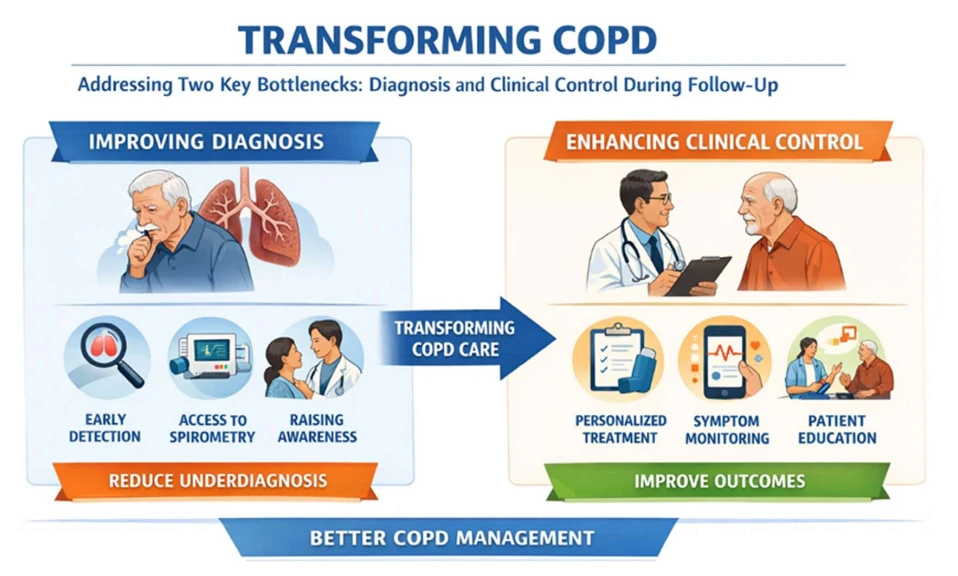

Transforming COPD by Addressing Two Key Bottlenecks: Diagnosis and Clinical Control During Follow-up
Transforming COPD by Addressing Two Key Bottlenecks
The challenge of COPD diagnosis and clinical control during follow-up
Chronic obstructive pulmonary disease (COPD) is a major global public health problem. Despite significant advances in our understanding of the pathobiology of the disease and the availability of novel treatments, COPD currently ranks third as a global cause of death. Here, we issue a call to action to improve this situation by addressing two major bottlenecks: diagnosis and management of COPD.
First, about 70% of patients with COPD worldwide remain undiagnosed; consequently, they are not treated.
Reducing underdiagnosis and misdiagnosis of COPD requires better education of patients, health care workers, administrators, and society in general about the burden of COPD. Artificial intelligence may help identify patients with respiratory symptoms and/or risk factors, such as smoking, in electronic health records or in the general population, as well as support the proper interpretation of spirometry. In any case, improving outcomes requires a shift from reactive management to proactive, stratified case finding.
Clinical control during COPD follow-up
Second, after an appropriate diagnosis, follow-up is necessary to assess disease progression and adopt the necessary therapeutic measures.
The RADAR score is a newly proposed tool to assess the degree of CC in routine clinical practice. It includes four core items: use of rescue medication, acute exacerbations, dyspnoea, and activity.
Patients who achieved CC, defined as a RADAR score of 0–1 points, showed a significantly lower incidence of adverse outcomes and reported better quality of life after 12 months of follow-up compared with those with partial CC or poor CC.
Moving towards proactive COPD management
RADAR can serve as an objective «impact» meter that may help break this inertia by supporting specific therapeutic measures based on treatable traits, such as treatment adherence, correct inhaler use, vaccination, comorbidities, and level of physical activity.
In summary, a more proactive diagnostic approach is necessary to address the currently unacceptable rates of underdiagnosis, misdiagnosis, and delayed diagnosis. Similarly, assessment of clinical control, and intervention when needed, is necessary during follow-up to improve the well-being and prognosis of these patients.
Authors
Patricia Sobradillo, Juan José Soler-Cataluña, Rodrigo Aispuru-Lanche, Alvar Agustí
Read more details at
Fecha de publicación
Available online 4 July 2026
Categorías asociadas al artículo
Noticias relacionadas

The EXACERBANTES Study (Exacerbation of Chronic Obstructive Pulmonary Disease According to the ANTES Proposal): Rationale, Goals and Design
The EXACERBANTES Study explores treatable traits in COPD exacerbations, aiming to improve risk assessment and support personalized clinical management.
A Brief History of COPD: As Told by Some of Its Senior Scientists and Clinicians
Explore the history of COPD and the evolution of disease concepts, treatment strategies, patient outcomes, pulmonary rehabilitation and clinical management.
Climate change and respiratory health: implications for respiratory clinicians in primary and specialist care
How climate change affects asthma and COPD, the role of air pollution and inhalers, and why sustainable respiratory care matters for patients and clinicians.
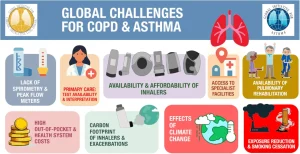
Addressing the Global Challenges of COPD and Asthma: A Shared Vision From the Global Initiative for Chronic Obstructive Pulmonary Disease (GOLD) and the Global Initiative for Asthma (GINA)
Analysis of the global challenges of COPD and asthma and the shared vision of GOLD and GINA to improve diagnosis, access to inhaled therapies and patient outcomes worldwide.
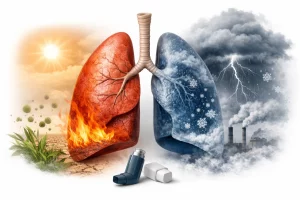
Climate change and respiratory health: implications for respiratory clinicians in primary and specialist care
Review on climate change and respiratory health, focusing on chronic respiratory diseases and implications for primary and specialist care.
Video del evento: Transformando la EPOC, claves para un manejo proactivo
Conferencia sobre el manejo proactivo de la EPOC centrada en el infradiagnóstico, el control clínico y el seguimiento estructurado del paciente.
Imagen obtenida del artículo de referencia