


A GOLD Science Committee Report on Universal Longitudinal Spirometry: A New Paradigm
Universal longitudinal spirometry for lifelong lung health
Over the last few decades, advances in prevention and treatment have transformed the landscape of several key chronic diseases.
By contrast, routine monitoring of lung function is absent despite compelling evidence that lung function predicts not only respiratory morbidity but also cardiometabolic conditions and overall mortality.
The paradigm shift we propose is to move spirometry from a diagnostic test performed after symptoms develop to a longitudinal measure of lung health used throughout the life course to identify abnormal trajectories early, guide preventive interventions, and preserve lifelong respiratory health.
Monitoring lung function from childhood
Accordingly, we argue that spirometry should be conducted universally from childhood, at periodic intervals throughout adolescence and into adulthood.
We recognize that the US Preventive Services Task Force (USPSTF) opposes populationbased spirometry screening, arguing it would not alter patient or physician behavior beyond recommending risk factor reduction, which should be enacted regardless of spirometry results.
Rather, spirometry should be viewed as a biomarker of lifelong health that enables the monitoring and interpretation of deviations from expected lung-function trajectories before irreversible disease develops.
Universal longitudinal spirometry: preserving lifelong lung health
Despite major successes in reducing mortality from other chronic diseases (e.g., cardiovascular), deaths from chronic lung disease continue to climb.
Establishing deviations from expected lung function trajectories early could enable the development of precision medicine approaches for lung disease.
The goal of spirometry should no longer be simply to diagnose disease, but to preserve lifelong lung health.
Authors
MeiLan K Han, Shawn D Aaron, Dinh Bui, Bartolome R Celli, Emily DeBoer, Shyamali Dharmage, David M G Halpin, Fernando J Martinez, Obianuju B Ozoh, Dave Singh, Claus Vogelmeier, Jadwiga Wedzicha, Alvar Agusti.
Read more details at
Fecha de publicación
Published: 29 September 2026
Categorías asociadas al artículo
Noticias relacionadas

Using AI for COPD Diagnosis, Equity, Guideline Gaps: Alvar Agusti, MD, PhD
AI in COPD diagnosis can support case finding, spirometry interpretation and equity while GOLD 2026 highlights validation and guideline gaps.
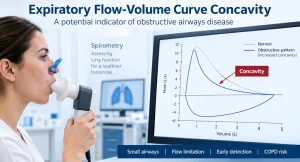
Concavity of the maximal expiratory flow–volume curve, and incidence of COPD and respiratory symptoms: a population-based cohort study
Expiratory flow-volume curve concavity predicts future respiratory symptoms but shows lower discriminatory accuracy for COPD incidence than FEV1/FVC.
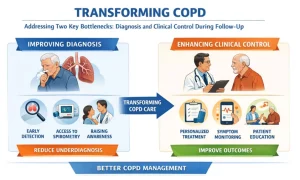
Transforming COPD by Addressing Two Key Bottlenecks: Diagnosis and Clinical Control During Follow-up
Learn why earlier COPD diagnosis and better clinical control during follow-up are essential to reduce exacerbations, improve quality of life and optimise patient outcomes.

The EXACERBANTES Study (Exacerbation of Chronic Obstructive Pulmonary Disease According to the ANTES Proposal): Rationale, Goals and Design
The EXACERBANTES Study explores treatable traits in COPD exacerbations, aiming to improve risk assessment and support personalized clinical management.
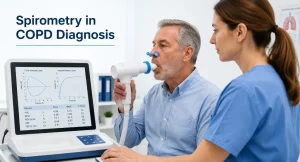
Joint statement from GOLD/GLI regarding the use of spirometry to define airflow obstruction and diagnose COPD
GOLD and GLI provide a joint position on spirometry for diagnosing COPD, supporting the fixed FEV1/FVC ratio in the appropriate clinical context.
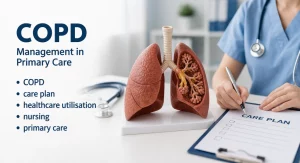
COPD Management in Primary Care: Underutilisation of Nursing Consultations
Analysis of COPD management in primary care highlighting the role and underutilisation of nursing consultations and healthcare utilisation patterns in real-world patients.
Imagen desarrollada con ChatGPT