
Concavity of the maximal expiratory flow–volume curve, and incidence of COPD and respiratory symptoms: a population-based cohort study

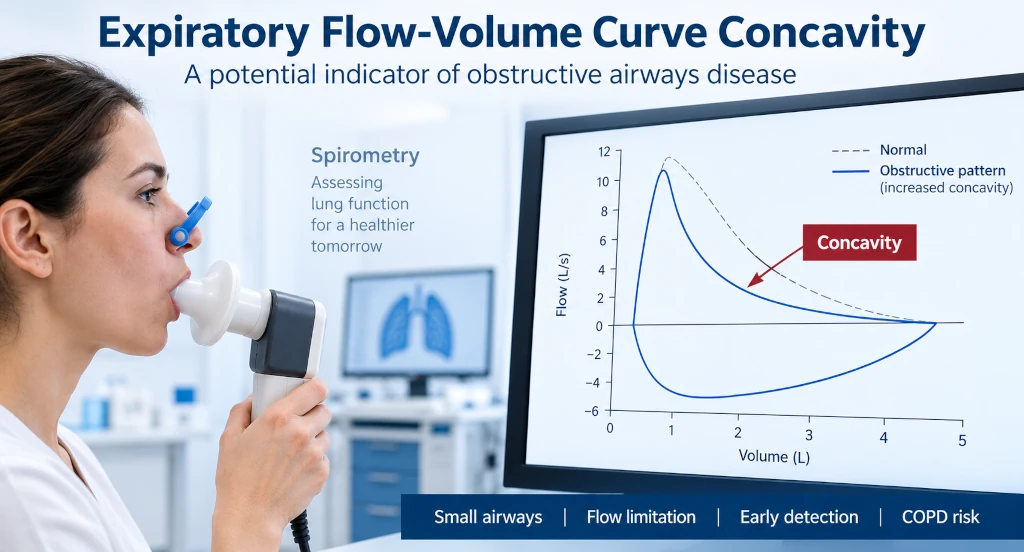
Expiratory flow-volume curve
Expiratory flow-volume curve concavity predicts future respiratory symptoms but shows lower discriminatory accuracy for COPD incidence than FEV1/FVC.

Expiratory Flow-Volume Curve Concavity and COPD Risk

Flow-Volume Curve Concavity as an Early Indicator

Concavity of the maximal expiratory flow–volume curve is widely regarded as an early indicator of obstructive airways disease, reflecting progressive loss of the small airways (diameter <2 mm) and airflow obstruction in mid-to-late expiration.

Narrowing and loss of the small airways typically precedes development of the characteristic physiological and radiological features of COPD, and up to 50% of the small airways are lost by the time COPD is diagnosed using conventional spirometric criteria.

Concavity Indices and Small Airways Disease

Quantitative measures of concavity have been repeatedly proposed as a marker of small airways disease and increase detection of airflow obstruction in community-based settings.

They are comparable to other measures of small airway function, and have the advantage of being readily derived from the routine spirometric flow–volume curve.

To date, few studies have examined the discriminatory accuracy of concavity indices for future incidence of COPD and/or respiratory symptoms.

Predicting COPD Incidence and Respiratory Symptoms

In this post hoc analysis of the TAHS cohort, we hypothesised that concavity indices can improve detection of individuals at risk of adverse respiratory outcomes compared to FEV1/FVC.

Our primary objective was to investigate the discriminatory accuracy of central and peripheral concavity, defined using a published method, for COPD incidence over an 8-year follow-up period, comparing their performance to that of post-BD FEV1/FVC.

Our secondary objective was to assess the association of central and peripheral concavity with incidence of respiratory symptoms.

Clinical Implications of Expiratory Flow-Volume Curve Concavity

This analysis examined the long-term implications of excess concavity in the expiratory flow–volume curve relative to FEV1/FVC within a general population sample during mid-adult life. While excess central and peripheral concavity were less accurate than post-BD FEV1/FVC as predictors of COPD, our findings indicate that they could be useful as clinical indicators of future respiratory symptoms. Future research should focus on longitudinal trajectories of large versus small airways function and their relationship with life-course respiratory health outcomes. Moving forward, RCTs of preventive therapies will be necessary to determine whether interventions in those identified by these physiological criteria can slow or prevent progression to symptoms and established COPD.

Authors

Daniel J. Tan, David P. Johns, Caroline J. Lodge, Dinh S. Bui, Don Vicendese, Garun S. Hamilton, MeiLan K. Han, Alvar Agusti, Michael J. Abramson, Jennifer L. Perret, Shyamali C. Dharmage, E. Haydn Walters

Read more details at

Fecha de publicación

Publication date: 12 January 2026.

Categorías asociadas al artículo

Noticias relacionadas

Imagen desarrollada ChatGPT

Entérate de
Nuestras Publicaciones

Loading
Logotipo Universitat de Barcelona - Càtedra de Salut Respiratòria
Resumen de privacidad

Esta web utiliza cookies para que podamos ofrecerte la mejor experiencia de usuario posible. La información de las cookies se almacena en tu navegador y realiza funciones tales como reconocerte cuando vuelves a nuestra web o ayudar a nuestro equipo a comprender qué secciones de la web encuentras más interesantes y útiles.