Academia Europaea’s guidelines for the visualization of clinical outcomes
Clinical Outcome Visualization in Healthcare Research
Bridging Complex Research Findings and Healthcare Decisions
In the increasingly data-rich domains of healthcare and health policy, translating research findings into actionable decisions and bridging the gap between complex research findings and effective policy decisions remains crucial.
Although there has been a substantial rise in peer-reviewed scientific publications over the past three decades, this surge in data and knowledge has not consistently been translated into corresponding reductions in avoidable mortality rates.
One potential reason for this is that policymakers, healthcare practitioners and researchers encounter abundant clinical data, often needing specialized knowledge to interpret it fully.
Clinical outcomes are complex to assess, requiring consideration of efficacy, safety and cost-effectiveness to inform effective healthcare policy.
Limitations of Traditional Clinical Data Visualization
Healthcare decision-making involves a delicate balance of multiple factors: efficacy, safety, cost and patient preferences, among others.
Traditional data-visualization techniques, such as forest plots, Kaplan–Meier survival curves, heat maps, decision-tree pathways, traffic-light models and Gantt charts, have long been employed to present research findings.
Although these tools serve their purpose within the academic community, they often fail to provide clear, actionable insights for policymakers, hospital administrators and frontline clinicians tasked with making real-world decisions.
The Ring Diagram Model for Translational Medicine
In response to this challenge, Academia Europaea launched a project to develop an innovative and intuitive tool for visualizing clinical research implications.
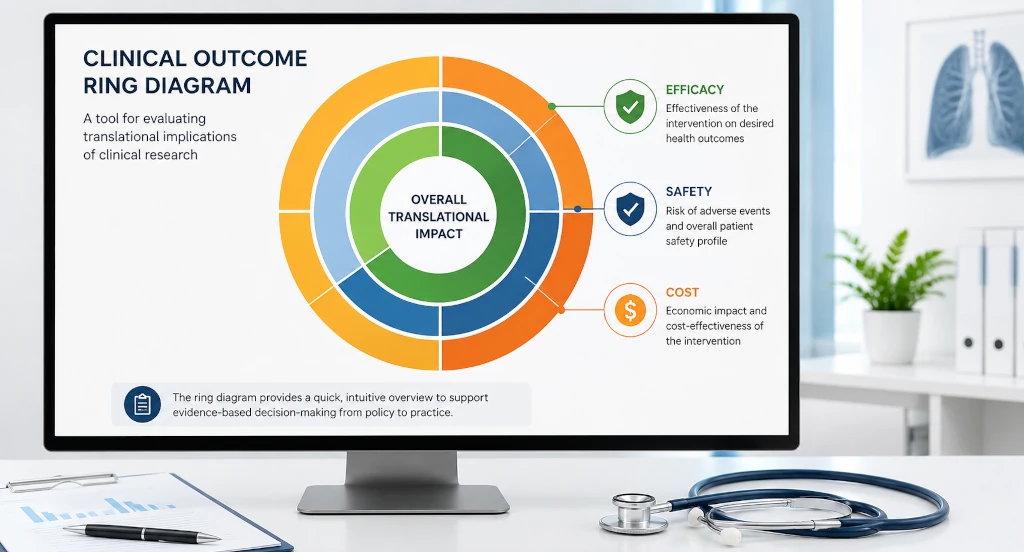
The result of this initiative is the ‘ring diagram model’, which serves as a novel approach to distilling complex, multidimensional data into a structured and easily interpretable format. The model facilitates decision-making by presenting clinical outcomes through concentric color-coded rings, clearly delineating key dimensions such as efficacy, safety and cost.
Supporting Evidence-Based Healthcare Decisions
This model offers a practical solution for translating clinical research into actionable, evidence-based decisions at all levels of healthcare, from policy to practice.
Authors
Peter Hegyi, Andras Garami, Alvar Agusti, Charles Agyemang, Arturo Anadon, Jozsef Balla, Maciej Banach, Derrick Bennett, Traolach Sean Brugha, Jan Buitelaar, Felix Carvalho, Jose Joaquin Ceron, Adam Cohen, Turgay Dalkara, Ann K. Daly, Peter Dayan, Wouter W. de Herder, Stefano Del Prato, Dobromir Dobrev, Maria Dorobantu, Margaret Esiri, Bart Fauser, Peter Ferdinandy, Gerasimos Filippatos, Rebecca Fitzgerald, Roberto Gambari, Arnold Ganser, Helen Giamarellou, Vivette Glover, Andrzej Grzybowski, Balazs Gulyas, Pancras C. W. Hogendoorn, Peter Holzer, Hilleke Hulshoff Pol, Heikki Joensuu, Gabor Juhasz, Jaakko Kaprio, Eva Kondorosi, Georg Langs, CS Lau, Jeffrey C. Laurence, Francesca Levi-Schaffer, Ronan A. Lyons, Aiping Lyu, M. N. V. Ravi Kumar, Giuseppe Mancia, Brendan McCormack, Iain McInnes, Hugh McKenna, Francis Megraud, Micheline Misrahi, Godefridus J. Peters, Ole H. Petersen, Vincent Piguet, Thierry Poynard, Ling Qin, Zeljko Reiner, Pieter Reitsma, Gerhard Rogler, Martin Rossor, Catherine Sackley, Philippa Saunders, Rainer Schulz, Matthias Schwab, Walter Sermeus, Shahrokh Shariat, Niels Erik Skakkebæk, Ewout W. Steyerberg, Michael Swash, Zoltan Szekanecz, Jean Paul Thiery, David R. Thompson, Andras Varro, Michael Vieth, Michel Wensing, John E. L. Wong, Jun Yu, Mone Zaidi, Alimuddin Zumla, Viktoria Barna, Marie Anne Engh, Richard Farkas, Andrea Harnos, Rita Nagy, Mahmoud Obeidat, Anett Rancz, Brigitta Teutsch, Gabor Varga, Szilard Vancsa, Alexander S. Wenning, Annapoorna Kuppuswamy, Kinga Morsanyi, Katalin Solymosi
Read more details at
Fecha de publicación
14 October 2025
Categorías asociadas al artículo
Noticias relacionadas

cfDNA profiling in COPD
Whole-genome cfDNA profiling identifies molecular clusters and pathways associated with oxidative damage and airflow limitation in COPD patients.
ECLIPSE: un estudio de tres años que cambió nuestra forma de entender la EPOC
A 20 años de ECLIPSE, repasamos el estudio que transformó la comprensión de la EPOC, revelando su heterogeneidad, progresión y biomarcadores clave.
Bronchiectasis and treatable traits: the journey from concept to clinical practice
Review of the treatable traits approach in bronchiectasis, exploring phenotypes, endotypes, comorbidities, and its translation into clinical practice.

Personalizing COPD care: phenotypes, endotypes, GETomics, the the trajectome, syndemics and treatable traits
Discover how personalized COPD care integrates phenotypes, endotypes, GETomics, trajectome, syndemics, and treatable traits to improve patient outcomes.
Imagen desarrollada ChatGPT