Exploring the association between eosinophils and autoimmunity in COPD
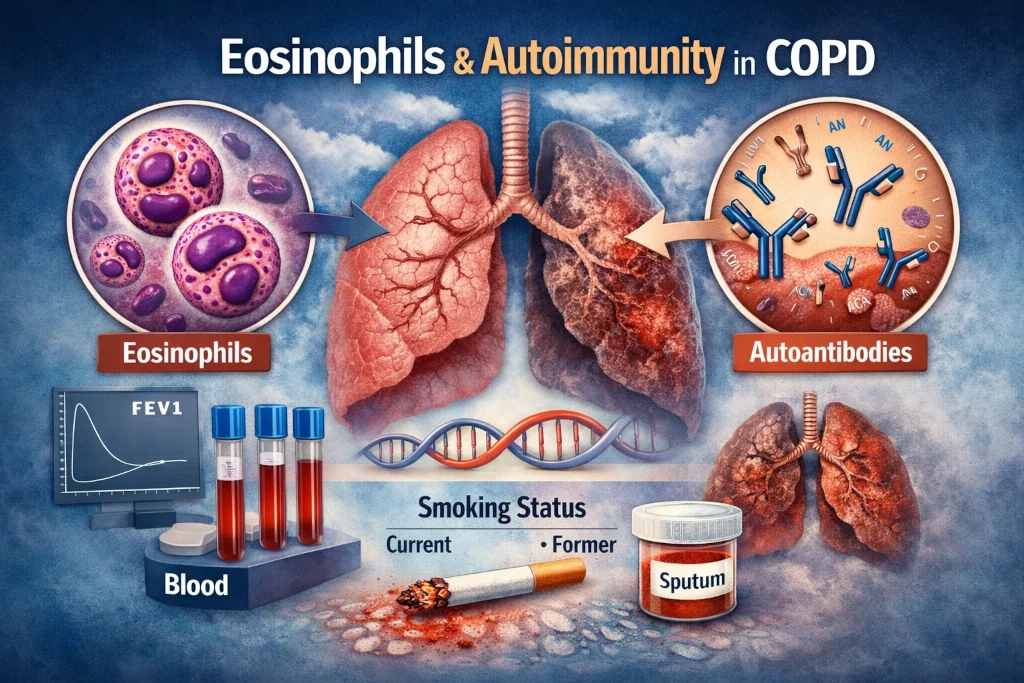
Eosinophils and autoimmunity in COPD
Introduction: Patients with Chronic Obstructive Pulmonary Disease (COPD) with severe airflow limitation and/or emphysema show increased autoantibody levels and an enhanced pulmonary Th17 response. Moreover, an eosinophilic phenotype of patients has been recently described.
However, the potential relationship between autoimmunity and eosinophils has not yet been explored.
Study aim
Aim: To explore the association between levels of circulating autoantibodies and eosinophils considering the severity of airflow obstruction (FEV1) and smoking status (current (CS) vs. former (FS)) in COPD patients.
Main findings
Results: In blood we observed significant associations between eosinophil % and AT presence (OR=1,27,p=0,006). In sputum, eosinophil % was associated with ANCA titers (OR=1,11,p=0,014).
When stratified by smoking status, CS showed an association between blood eosinophil % and both AT and ANCA presence, while FS showed an association between sputum eosinophil % and ANCA presence.
Sensitivity analysis adjusting by FEV1 or CO diffusing capacity (a marker of emphysema) showed similar results.
Conclusion
Conclusion: Eosinophil levels are associated with several autoantibodies and this relationship depends on smoking status, suggesting a more profound immune dysfunction.
Authors
Alejandro Torvisco Tello, Sandra Casas, Àlvar Agustí, Judith Garcia-Aymerich, Rosa Faner
Read more details at
Fecha de publicación
Published online 18 November 2025
Categorías asociadas al artículo
Noticias relacionadas

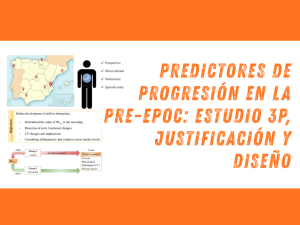
Predictores de progresión en la pre-EPOC: estudio 3P, justificación y diseño
Conoce el estudio 3P que analiza los factores que predicen la progresión de la pre-EPOC a EPOC en fumadores con espirometría normal.
General population-based lung function trajectories over the life course: an accelerated cohort study
Empirical life course lung function trajectories from ages 4–80 using data from eight cohort studies in Europe and Australia.
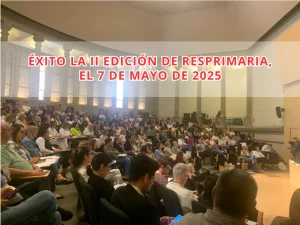
Éxito en la segunda edición de RESPrimaria en la UB
La Segunda Edición de RESPrimaria reunió a 350 profesionales en la UB con sesiones clínicas sobre EPOC, IA, nutrición, salud mental y ventilación no invasiva.
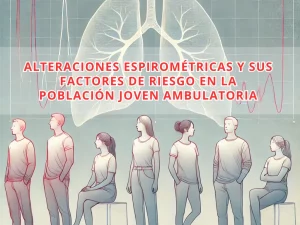
Alteraciones espirométricas y sus factores de riesgo en la población joven ambulatoria
Un estudio reciente en Osona (Cataluña) refleja que 20,7% de jóvenes presenta alteraciones espirométricas. También revela síntomas y factores de riesgo en la población joven ambulatoria.

II edición RESPrimaria, 7 de mayo de 2025
No te pierdas la II edición RESPrimaria el próximo 7 de mayo. Inscríbete en formato Streaming o solicita tu invitación presencial. ¡Plazas limitadas!

Entrevista SEMG al Dr. Alvar Agusti, Experto en la II Jornada Resprimaria
Descubre los avances en el diagnóstico y tratamiento de la EPOC con el Dr. Alvar Agustí en la II Jornada SEMG Resprimaria. Conoce la importancia de la espirometría, la detección precoz y las nuevas estrategias terapéuticas.
Imagen desarrollada con IA (ChatGPT)