Indoor radon exposure and COPD in never smokers: a case–control study in a radon-prone area in Spain
Indoor radon COPD risk in never smokers
Background and Objective on indoor radon COPD
Previous studies have linked radon exposure with mortality in patients with chronic obstructive pulmonary disease (COPD), but there is little data assessing the role of indoor radon exposure with the risk of COPD or its severity in never smokers.
Objective: To explore whether indoor radon exposure is associated with the risk or severity of COPD in never smokers.
Methods for assessing indoor radon exposure and COPD
Multicentric, hospital-based, case–control study, located in Northwest Spain. The study included 300 never-smokers with COPD (cases) and 462 never smoking controls. COPD cases and their severity were included following Global Initiative for Obstructive Lung Disease 2019 (GOLD) criteria for COPD diagnosis.
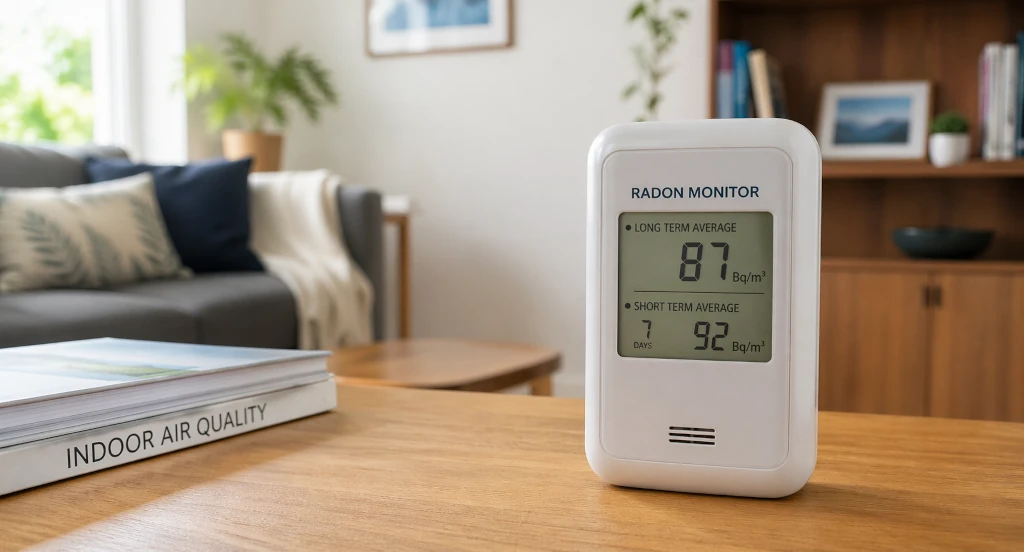
Radon concentrations were measured in each participant’s home using long-term (at least 3 months) alpha-track devices.
Results linking indoor radon and COPD severity
Indoor radon exposure was similar in cases and controls, but radon exposure showed a statistically significant association with COPD when length of residence in the same dwelling was > 40 years.
There was an odds ratio (OR) of 2.79 (1.06–7.40) for those with highest (> 300 Bq/m3) vs. lowest radon exposure (< 100 Bq/m3).
In cases, the severity of airflow obstruction increased with higher indoor radon exposure, and the proportion of COPD cases with radon exposure above 300 Bq/m3 was higher in GOLD 4 (50%) vs. GOLD 1 (9%).
Conclusions on indoor radon COPD association
Although indoor radon exposure was not higher in cases compared to controls, the association increased for those with higher exposures who lived for longer periods in the same dwelling, reaching statistical significance when length of residence was higher than 40 years. In COPD cases, higher radon exposure was associated with more severe airflow limitation.
Authors
Carlota Rodríguez García, Alberto Ruano Raviña, Alvar Agustí, Cristina Represas Represas, Rafael Golpe, Karl Kelsey, Ana Pando Sandoval, Angélica Consuegra Vanegas, Cecilia Mouronte Roibás, Tara Pereiro Brea, Cristina Candal Pedreira, Guadalupe García, Raquel Dacal-Quintas, Julia Rey Brandariz, Luis Valdés, Alberto Fernández Villar, Lucia Martin-Gisbert
Read more details at
Fecha de publicación
17 February 2026
Categorías asociadas al artículo
Noticias relacionadas

Residential greenspace and lung function throughout childhood and adolescence in five European birth cohorts. A CADSET initiative
Study of five European cohorts found no association between residential greenness or urban green space and lung function throughout childhood and adolescence.

Climate Change & COPD: A GOLD Science Committee Review
Climate change and COPD are linked through extreme temperature, wildfire smoke, dust storms and allergen exposure, which pose major health threats.
Monitoring and assessment of CO2 and NO2 in schools within the Sentinel Schools Network of Catalonia during the COVID-19 era
Explore how the COVID-19 Sentinel Schools Network of Catalonia monitored CO2 and NO2 levels in classrooms, revealing key findings on ventilation and air quality in schools across Catalonia during the pandemic.
COPD and multimorbidity: recognising and addressing a syndemic occurrence
Most patients with chronic obstructive pulmonary disease (COPD) have at least one additional, clinically relevant chronic disease. Those with the most severe airflow obstruction will die from respiratory failure, but most patients with COPD die from non-respiratory disorders, particularly cardiovascular diseases and cancer.
Air pollution and COPD: GOLD 2023 committee report
Exposure to air pollution is a major contributor to the pathogenesis of chronic obstructive pulmonary disease (COPD) worldwide.
Imagen desarrollada ChatGPT