
Safety and efficacy of astegolimab for COPD with frequent exacerbations regardless of baseline blood eosinophil counts (ALIENTO and ARNASA): randomised, double-blind, placebo-controlled, phase 2b and 3 trials
Astegolimab for COPD with frequent exacerbations
Targeting the ST2/IL-33 pathway in COPD
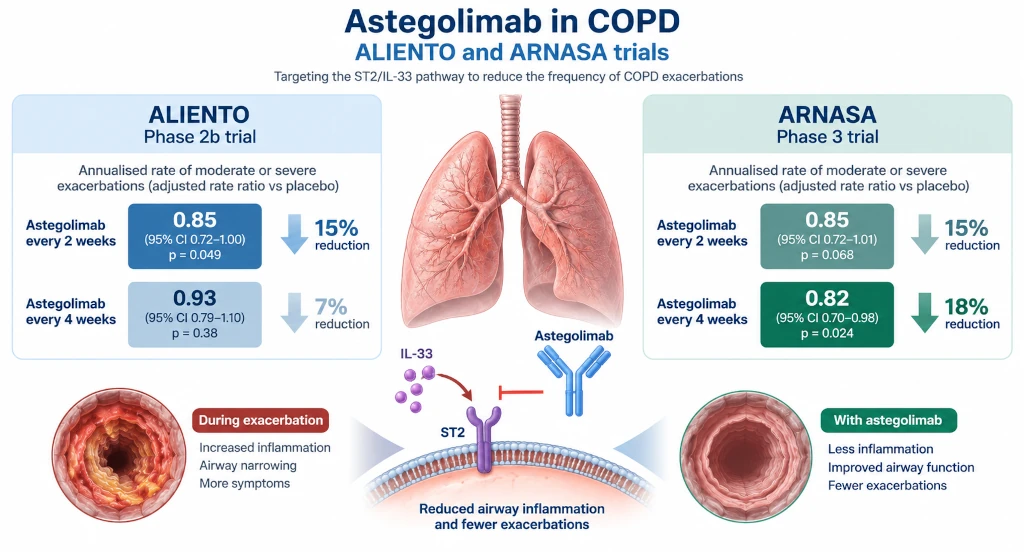
Interleukin-33 and its receptor, ST2, are implicated in neutrophilic and eosinophilic inflammation during chronic obstructive pulmonary disease (COPD) exacerbations.
We aimed to assess the efficacy and safety of astegolimab, an anti-ST2 human IgG2 monoclonal antibody, which were evaluated in two COPD pivotal trials.
ALIENTO and ARNASA trials
In two randomised, double-blind, placebo-controlled trials (phase 2b ALIENTO and phase 3 ARNASA), current or former smokers with COPD and a history of frequent exacerbations, irrespective of baseline blood eosinophils, were randomly assigned (1:1:1; stratification by smoking status and region) to receive subcutaneous astegolimab 476 mg every 2 weeks, every 4 weeks, or placebo, alongside optimised inhaled maintenance therapy over 52 weeks. The primary endpoint (analysed in participants receiving one or more doses) was annualised rate of moderate or severe exacerbations.
Astegolimab and COPD exacerbation rates
Adjusted rate ratios versus placebo for the primary endpoint were 0·85 (95% CI 0·72–1·00; p=0·049) for astegolimab every 2 weeks and 0·93 (0·79–1·10; p=0·38) for astegolimab every 4 weeks in ALIENTO, and 0·85 (0·72–1·01; p=0·068) for astegolimab every 2 weeks and 0·82 (0·70–0·98; p=0·024) for astegolimab every 4 weeks in ARNASA.
Astegolimab and the ST2/IL-33 pathway
In ALIENTO, astegolimab every 2 weeks was associated with a lower annual rate of exacerbations versus placebo in patients with COPD and a history of frequent exacerbations.
In ARNASA, these findings did not meet statistical significance. Together, these findings suggest a role for targeting the ST2/IL-33 pathway to reduce the frequency of COPD exacerbations in patients with limited treatment options.
Authors
Alberto Papi, Neil J Greening, Surya P Bhatt, Nicolas Roche, Bartolome Celli, Jadwiga A Wedzicha, Àlvar Agustí, Ruth Tal-Singer, MeiLan K Han, Wim Janssens, Nicola A Hanania, Parameswaran Nair, Peter Bremner, Konstantinos Porpodis, Yoko Shibata, Stephanie Korn, Ting Yang, Oliver Gordon, Rebecca Saenz, Julie Ng, Dorothy S Cheung, Jacob Devine, Michele A Grimbaldeston, Wenhui Zhang, Xiaoying Yang, Divya Mohan, Claus F Vogelmeier, Christopher E Brightling, on behalf of the ALIENTO and ARNASA investigators
Read more details at
Fecha de publicación
May 23, 2026 — Publication date.
Categorías asociadas al artículo
Noticias relacionadas

Characterisation of the gut-lung axis microbiome in clinically stable patients with chronic obstructive pulmonary disease
Gut-lung axis microbiome analysis in stable COPD reveals distinct gut and lung microbiomes associated with airflow limitation, exacerbations and ICS use
Key recommendations for primary care from the 2026 GOLD update
2026 GOLD update: key recommendations for primary care on COPD diagnosis, assessment, prevention, treatment, exacerbations and emerging technologies.

The EXACERBANTES Study (Exacerbation of Chronic Obstructive Pulmonary Disease According to the ANTES Proposal): Rationale, Goals and Design
The EXACERBANTES Study explores treatable traits in COPD exacerbations, aiming to improve risk assessment and support personalized clinical management.
A Brief History of COPD: As Told by Some of Its Senior Scientists and Clinicians
Explore the history of COPD and the evolution of disease concepts, treatment strategies, patient outcomes, pulmonary rehabilitation and clinical management.
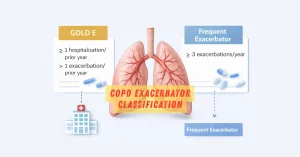
“GOLD E” VERSUS “FREQUENT EXACERBATOR” CLASSIFICATIONS IN COPD: A PROTEO-METABOLOMIC PERSPECTIVE [COMUNICACIÓN PREMIADA]
Comparison of COPD exacerbator classification systems (GOLD E vs Frequent Exacerbator) using proteomics and metabolomics to identify biological differences and biomarkers.
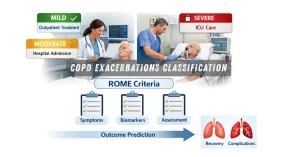
The ROME COPD exacerbation proposal works! Time to move forward
The ROME proposal for COPD exacerbations classification offers a new approach to assess severity and predict outcomes, improving clinical decision-making
Imagen desarrollada con ChatGPT