A Pilot Study on Proteomic Predictors of Mortality in Stable COPD
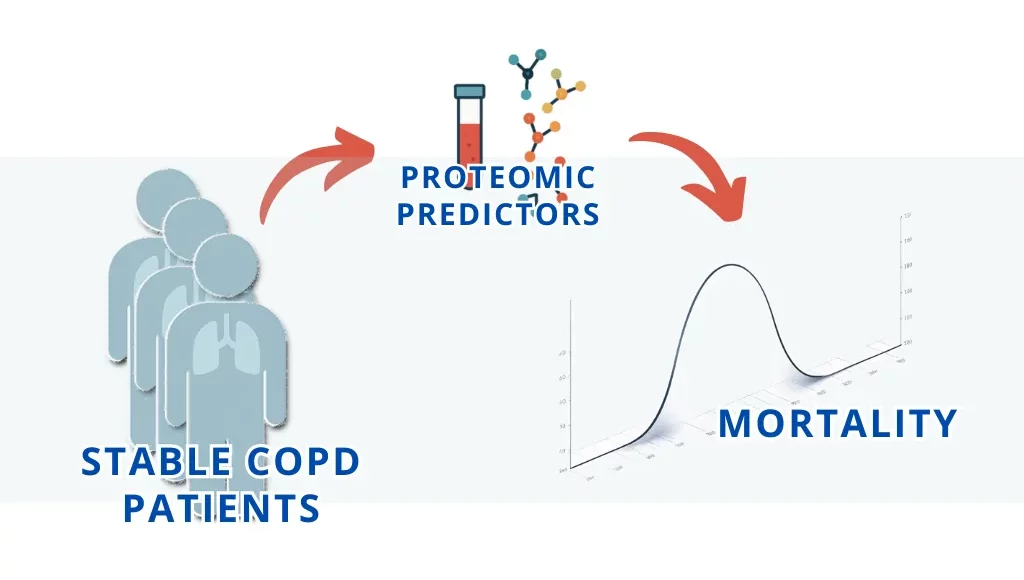
Proteomic predictors of mortality in COPD and their connection to respiratory, cardiovascular, and cancer-related deaths
Can Proteomic Predictors of Mortality Help Forecast Outcomes in Stable COPD?
Most of the long-term deaths are attributable to respiratory causes, with lower percentages attributed to cardiovascular/cerebrovascular events or cancer.
It is worth nothing that a trend toward better prognoses (disease progression, exacerbations, and mortality) has been observed in the last few years.
This phenomenon may be due to recent changes in treatment and involves the need for new studies on the current predictors of mortality.
Studying proteomic predictors of mortality in COPD to improve survival prognosis
Therefore, the objective of this pilot study was to identify proteomic markers and specific multiprotein signatures that could be useful in predicting long-term mortality, identifying the related pathways and contributing to our knowledge on the mechanisms linked to a poor prognosis for COPD patients.
Proteomic predictors of mortality in COPD: Understanding the biological mechanisms involved in future deaths in long-term patients
A proteomic blood signature found in stable COPD patients can help in establishing their long-term (4-year) survival prognosis.
The most important elements for establishing this prognosis are proteins/peptides linked to the hemostatic and inflammatory statuses during the stable phase, as well as different elements of the immune response.
Furthermore, the present results may help us to better understand the biological mechanisms involved in future deaths in long-term patients.
Authors
Cesar Jessé Enríquez-Rodríguez, Carme Casadevall, Rosa Faner, Sergi Pascual-Guardia, Ady Castro-Acosta, José Luis López-Campos, Germán Peces-Barba, Luis Seijo, Oswaldo Antonio Caguana-Vélez, Eduard Monsó, Diego Rodríguez-Chiaradia, Esther Barreiro, Borja G. Cosío, Alvar Agustí, Joaquim Gea and on behalf of the BIOMEPOC Group
Read more details at
Fecha de publicación
Published: 14 August 2024
Categorías asociadas al artículo
Noticias relacionadas

A Brief History of COPD: As Told by Some of Its Senior Scientists and Clinicians
Explore the history of COPD and the evolution of disease concepts, treatment strategies, patient outcomes, pulmonary rehabilitation and clinical management.

High prevalence of obstructive sleep apnea in patients with Long-COVID
Sleep apnea is highly prevalent in Long-COVID patients. Sleep studies may help identify treatable causes of persistent symptoms and insomnia.

Climate change and respiratory health: implications for respiratory clinicians in primary and specialist care
How climate change affects asthma and COPD, the role of air pollution and inhalers, and why sustainable respiratory care matters for patients and clinicians.

Academia Europaea’s guidelines for the visualization of clinical outcomes
Academia Europaea proposes ring diagrams to improve clinical outcome visualization and support evidence-based healthcare decision-making.

Indoor radon exposure and COPD in never smokers: a case–control study in a radon-prone area in Spain
Study on indoor radon exposure and its association with COPD risk and severity in never smokers in a radon-prone region.

“GOLD E” VERSUS “FREQUENT EXACERBATOR” CLASSIFICATIONS IN COPD: A PROTEO-METABOLOMIC PERSPECTIVE [COMUNICACIÓN PREMIADA]
Comparison of COPD exacerbator classification systems (GOLD E vs Frequent Exacerbator) using proteomics and metabolomics to identify biological differences and biomarkers.
Imagen desarrollada DALL·E, Canva y Diseño gráfico